
GRÂCE AU SYSTÈME DE SOULAGEMENT DE LA DOULEUR ON-Q*, LES PATIENTS:
- Sont rentrés chez eux en moyenne 1,1 jour plus tôt1–4
- Ont déclaré ressentir une douleur jusqu’à 69 % inférieure5–6
- Se sont dits jusqu’à trois fois plus satisfaits4,7–8
- Sont plus susceptibles de connaître une meilleure prise en charge de la douleur avec moins d’effets secondaires1,7,9
APERÇU DES DONNÉES RÉCENTES SUR LA BUPIVACAÏNE LIPOSOMALE (BL)
Une revue clinique de 3 articles sur BL, publiés dans « Anesthesiology » en février 2021
AVEC ON-Q*, LES CLINICIENS PEUVENT RÉDUIRE:
- Les douleurs et les nausées post-opératoires1,9
- La période de convalescence1-4
- Les risques d’infection10-13–avec l’utilisation d’une pompe à usage unique pour chaque patient
- Le nombre d’hospitalisations imprévues à la suite d’interventions ambulatoires,14,15
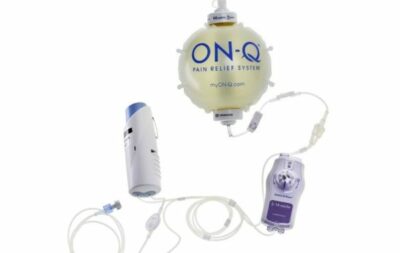
POMPES D’ANALGÉSIE AMBULATOIRE ON-Q*
Des solutions innovantes pour le traitement des douleurs du site opératoire et de l’anesthésie régionale
References:
1. Forastiere E, Sofra M, Giannarelli D, Fabrizi L, Simone G. Effectiveness of continuous wound infusion of 0.5% ropivacaine by ON-Q Pain Relief System for postoperative pain management after open nephrectomy. Br J Anaesth. 2008;101(6):841-847.
2. White PF, Rawal S, Latham P, et al. Use of a continuous local anesthetic infusion for pain management after median sternotomy. Anesthesiology. 2003;99(4):918-923.
3. Dowling R, Thielmeier K, Ghaly A, Barber D, Boice T, Dine A. Improved pain control after cardiac surgery: results of a randomized, double-blind, clinical trial. J Thorac Cardiovasc Surg. 2003;126(5):1271-1278.
4. Liu SS, Richman JM, Thirlby RC, Wu CL. Efficacy of continuous wound catheters delivering local anesthetic for postoperative analgesia: a quantitative and qualitative systematic review of randomized controlled trials. J Am Coll Surg. 2006;203(6):914-932.
5. Sherwinter DA, Ghaznavi AM, Spinner D, Savel RH, Macura JM, Adler H. Continuous infusion of intraperitoneal bupivicaine after laparoscopic surgery: a randomized controlled trial. Obes Surg. 2008;18(12):1581-1586.
6. Klein SM, Grant SA, Greengrass RA, et al. Interscalene brachial plexus block with a continuous catheter insertion system and a disposable infusion pump. Anesth Analg. 2000;91(6):1473-1478.
7. Beaussier M, El’Ayoubi H, Schiffer E, et al. Continuous preperitoneal infusion of ropivacaine provides effective analgesia and accelerates recovery after colorectal surgery. Anesthesiology. 2007;107(3):461-468.
8. Heller L, Kowalski AM, Wei C, Butler CE. Prospective, randomized, double-blind trial of local anesthetic infusion and intravenous narcotic patient-controlled anesthesia pump for pain management after free TRAM flap breast reconstruction. Plast Reconstr Surg. 2008;122(4):1010-1018.
9. Cansler V, B2B Team. Patient Pain Survey/GMR&A Summary. Study: 26199. July 13, 2012.
10. McCaughey, Betsy. Unnecessary Deaths: The Human and Financial Costs of Hospital Infections. www.hospitalinfection.org p. 6.
11. Falk, P et al. Outbreak of vancomycin-resistant enterococci in a burn unit. Infection Control and Hospital Epidemiology 2000;21:575-582.
12. Rothwell et al. Bacterial contamination of PCA and epidural infusion devices. Anaesthesia 2009;64:751-753.
13. Wang, J et al. Morphine impairs host innate immune response and increases susceptibility to streptococcus pneumonie lung infection. The Journal of Immunology 2005;174:426-434.
14. Capdevila X, Dadure C. Perioperative management for one day hospital admission: regional anesthesia is better than general anesthesia. Acta Anaesth Belg. 2004;55(suppl):1-4.
15. Gold BS, et al. Unanticipated Admission to the Hospital following Ambulatory Surgery, JAMA 1989: 262 (21):3008-10.